Buying the wrong jib crane is an expensive mistake. A unit that is under-rated will fail load testing and put your workers at risk. A unit that is over-specified ties up capital you did not need to spend. Most of the confusion comes down to three decisions: how much the crane must lift, how far the arm must swing, and how it will be fixed in place. This guide explains each one in plain terms so you can brief a supplier with confidence.
What a Jib Crane Is Used For
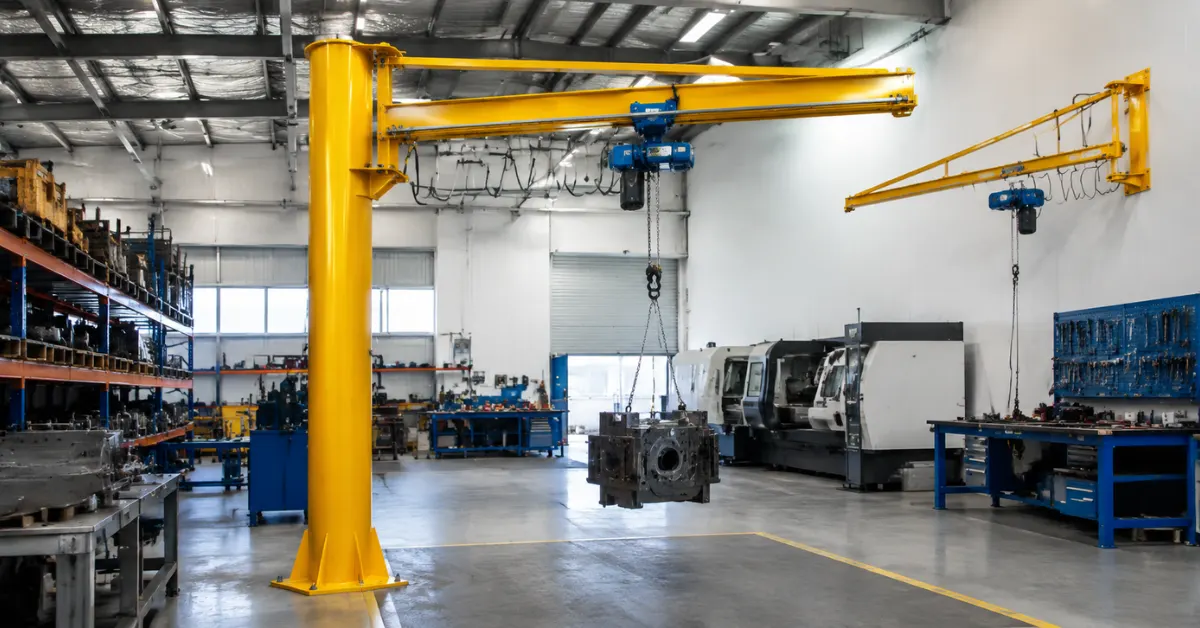
A jib crane has a horizontal arm, or boom, that pivots from a fixed column or a wall bracket. A hoist runs along the arm to lift and move loads within a circular or semi-circular working area. Jib cranes are popular in workshops, loading bays and machining cells because the pivoting arm rotates seamlessly and works well in limited spaces where an overhead crane would not fit.
Step 1: Work Out the Capacity You Need
Capacity is the maximum weight the crane is rated to lift safely. To size it correctly, do the following:
• Weigh the heaviest load, not the average. Rate the crane for the worst-case load it will ever handle.
• Add the weight of the lifting gear. The hoist, chains, slings and any lifting beam all count against the rated capacity.
• Allow a margin. Choosing a rating with headroom above your heaviest load reduces stress on the equipment over its service life.
Leading Cranes supplies jib cranes to suit specific industry requirements, and pairs them with the right hoist. A 250kg jib crane fitted with an electric chain hoist is a common workstation configuration, while heavier duties are matched to a larger hoist.
Step 2: Set the Reach and Rotation
Reach is the length of the arm, which sets how far the hoist can travel from the column. Rotation is the angle through which the arm swings. The arm on a Leading Cranes jib is engineered to adjust to varying lengths, so the reach can be matched to the task rather than forced to fit a standard size.
• Map the work area first. Measure the furthest point a load must reach and the pick-up point, then set the arm length from that.
• Check for obstructions. Columns, racking, machinery and doorways can all limit how far the arm can swing.
• Match rotation to the layout. A floor mounted column can offer a wide sweep, while a wall mounted arm covers a defined arc along a wall.
Step 3: Plan the Installation
How the crane is mounted decides what it can do and what the site must provide.
• Floor mounted jib cranes stand on their own column and need a suitable concrete foundation to carry the load and turning force.
• Wall mounted jib cranes bolt to an existing structural wall or column and free up floor space, provided the structure can support the load.
Every jib crane from Leading Cranes is built in strict alignment with Australian safety standards. Correct installation matters as much as the crane itself, which is why professional installation, inspection and commissioning are part of the package rather than an afterthought.
Match the Hoist to the Job
The jib crane and the hoist are chosen together, because the hoist sets how the load is actually lifted. The hoist must be rated to at least the capacity of the crane, and it is sized to the load, the lift height and the site conditions. A lighter workstation duty is well served by a chain hoist, while a heavier duty calls for a larger hoist. Getting this pairing right is why the crane and hoist are specified as one package rather than bought separately.
A Common Problem and How to Avoid It
A frequent issue is ordering a jib crane on capacity alone and discovering on install day that the foundation cannot carry the turning force, or that the arm fouls a doorway. The fix is simple: confirm capacity, reach, rotation and mounting together, and have the site assessed before the order is placed. A supplier that offers installation, maintenance and inspection under one roof can catch these problems early.
A Quick Checklist Before You Enquire
Have these details ready and the specification process moves faster:
• The heaviest load, plus the weight of the hoist and lifting gear.
• The furthest point the load must reach, and the pick-up point.
• The rotation you need, and any columns, racking or doorways in the way.
• Whether you want floor or wall mounting, and the condition of the floor or wall.
• Any environmental conditions on site, such as explosion-proof requirements.
Frequently Asked Questions
What capacity jib cranes are available?
Leading Cranes supplies jib cranes tailored to specific industry requirements, matched with a suitable chain or wire rope hoist. Share the heaviest load and the application, and the crane is specified to suit.
Can the arm length be customised?
Yes. The jib arm is engineered to adjust to varying lengths, so the reach is set to the task rather than a fixed size.
Do you install the jib crane as well as supply it?
Yes. Leading Cranes provides installation, maintenance and detailed inspection, so one provider handles the full process.
Is the crane compliant with Australian standards?
Every jib crane is constructed in strict alignment with Australian safety standards, and every service adheres to those standards.


Leave a Reply