Both floor mounted and wall mounted jib cranes do the same core job: they pivot a hoist over a working area to lift and place loads. The difference is how they are fixed and what that means for your floor space, your building and your coverage. Choosing the wrong type leads to wasted floor area or a mounting wall that cannot take the load. This guide sets out where each type works best.
Floor Mounted Jib Cranes
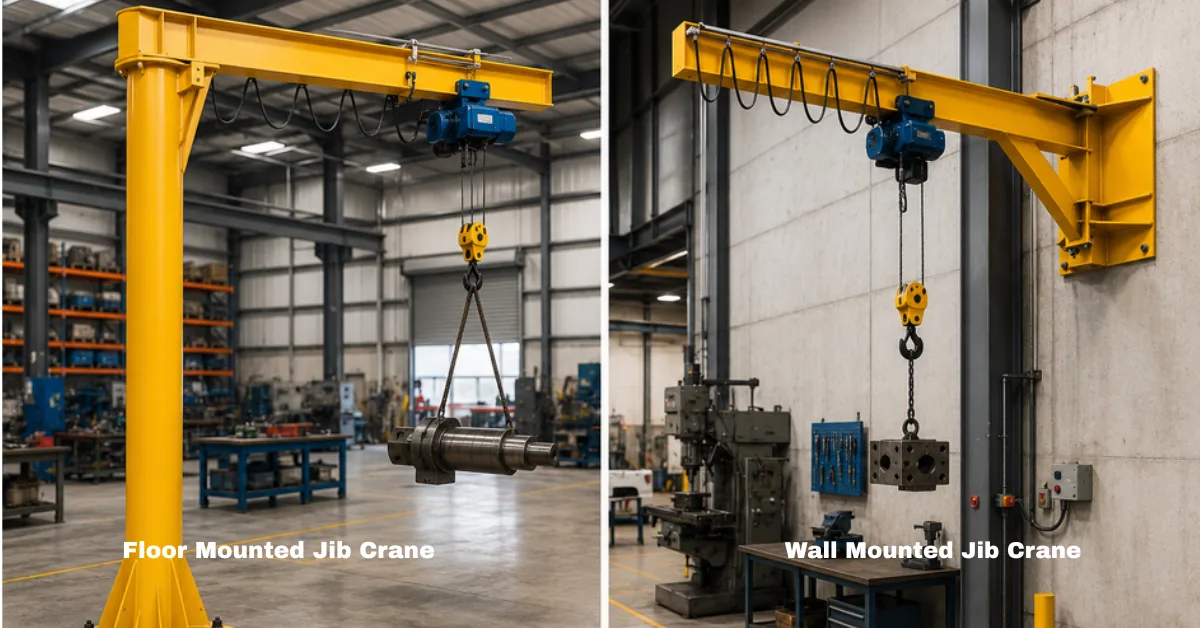
A floor mounted jib crane stands on its own column, which is fixed to a concrete foundation. Because it does not rely on the building, it can be placed almost anywhere the foundation allows.
Strengths
• Independent of the building structure, so it can sit in the middle of a workshop or an open bay.
• Able to offer a wide rotation around the column, covering a large circular area.
• Suited to higher capacities and longer reach, since the load is carried by a dedicated column and foundation.
Points to Consider
• Needs a suitable concrete foundation, which adds to the installation requirements.
• Takes up floor space at the column base.
Wall Mounted Jib Cranes
A wall mounted jib crane bolts to an existing structural wall or building column. The arm swings along the wall to cover a defined arc.
Strengths
• Frees up floor space because there is no column standing on the floor.
• Uses the existing building structure, so no separate foundation is required.
• A practical way to add lifting to a specific station, such as a machine or a bench along a wall.
Points to Consider
• The wall or column must be strong enough to carry the load and the turning force.
• Rotation is limited to an arc against the wall rather than a full sweep.
How to Decide
Work through these questions in order:
1. Where is the work?
If lifting happens along a wall or at a fixed station, a wall mounted unit suits. If it happens in the open or the middle of a bay, a floor mounted unit suits.
2. How much floor space can you spare?
If floor area is tight, a wall mounted crane keeps the floor clear.
3. Can the building take the load?
Wall mounting depends on a structural wall or column that can carry the crane. If it cannot, a floor mounted column with its own foundation is the answer.
4. What coverage do you need?
A wide circular area points to floor mounted. A defined arc points to wall mounted.
What Both Types Share
The mounting is the main difference, but the core benefits are the same across both types. Whichever you choose from Leading Cranes, you get:
• A jib arm that rotates seamlessly, which is valuable in limited spaces.
• A customisable arm length, engineered to adjust to varying lengths so the reach suits the task.
• Faster loading and unloading, which keeps work on schedule.
• Construction in strict alignment with Australian safety standards.
Both types are also backed by the same installation, maintenance and inspection service, so support does not depend on which mounting you pick.
Quick Comparison
In short, a floor mounted jib is the independent, wide-coverage option that needs its own foundation and floor space. A wall mounted jib is the space-saving option that uses your building and covers a defined arc, provided the structure can carry it. Neither is better in every case. The right one is the one that fits the location and the load.
A Real Scenario
A fabrication shop wants to feed parts to a single machine set against a wall. Floor space is already tight with racking and traffic. A wall mounted jib crane fixes to the existing column, keeps the floor clear and covers the machine within its arc. If the same shop later needs lifting in an open assembly bay with no wall nearby, a floor mounted jib on its own foundation is the correct choice there. The point is to match the mounting to the location, not to pick one type for the whole site.
Frequently Asked Questions
Which type saves more floor space?
A wall mounted jib crane frees up floor space because it fixes to an existing wall or column and has no base standing on the floor.
Does a wall mounted crane need a special wall?
It needs a structural wall or building column strong enough to carry the load and the turning force. A site assessment confirms this before installation.
Which type offers wider coverage?
A floor mounted jib on its own column can offer a wider rotation around the column, while a wall mounted arm covers a defined arc along the wall.
Can Leading Cranes help me choose?
Yes. Leading Cranes supplies both types with installation and inspection, and can assess your site and application to recommend the right mounting.


Leave a Reply