A wire rope hoist is the part of your crane that carries the load, so when it fails, the whole operation stops. Equipment downtime is more than an inconvenience, because it hits production, project timelines and site safety at the same time. The good news is that most hoist failures build up slowly and give warning signs first. A steady maintenance routine catches those signs early and keeps the hoist working for years longer. This guide sets out practical steps to protect your investment.
Why Wire Rope Hoists Need Regular Care
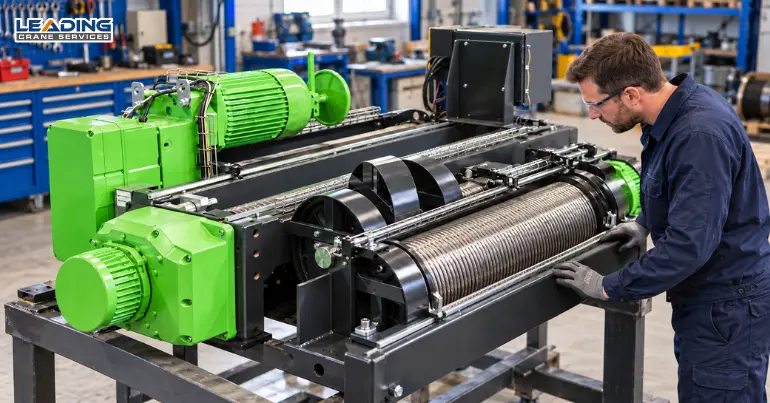
Wire rope hoists at Leading Cranes range in capacity from 500kg to 60 tonnes and are used in heavy-duty, high-cycle work. That kind of duty puts constant stress on the rope, the drum, the brakes and the drive. Every site also has different environmental and production conditions, so a hoist in a dusty quarry or a molten metal application wears differently to one in a clean workshop. Regular maintenance is what keeps the hoist safe and reliable across all of these settings.
Everyday Checks That Prevent Big Problems
The most effective way to manage a hoist is to prevent issues before they arise. A short routine, carried out consistently, does most of the work:
- Inspect the wire rope. Look for frayed strands, kinks, flattening or corrosion. Damaged wires and worn hooks are a safety risk and need repair before the hoist is used again.
- Check functional controls. Confirm the hoist runs at the correct speeds and stops cleanly, so operation stays safe.
- Test emergency stops and interlocks. Make sure emergency stop switches and safety interlocks shut the system down correctly when required.
- Keep it lubricated. Ensure moving components are properly lubricated and fluid levels are maintained for smooth, reliable operation.
- Look over structural and mechanical parts. Inspect critical components for wear, damage or early signs of failure.
- Read the signage. Confirm load markings and safety labels are clear and compliant.
Any fault found during these checks should be logged and actioned. Small problems are cheap to fix. The same problem left alone becomes a breakdown.
Do Not Ignore the Brake and the Drive
Two areas deserve extra attention on a wire rope hoist. The braking system holds the load, so it must be inspected and kept in safe working condition. If your hoist is fitted with a secondary hoisting brake, that backup needs checking too. The drive is the other priority. Inverter-driven hoists give smoother acceleration and deceleration, which reduces shock loading on the rope and gearing, so keeping the drive in good order protects the rest of the hoist.
Follow the Service Schedule and Stay Compliant
Operating a crane in Australia carries real legal obligations. Under Australian Standard AS 2550.1, most cranes must be serviced every three months, with an annual inspection. Equipment working in harsh conditions or high-cycle use may need more frequent inspections. All maintenance should be done in full compliance with AS 2550.1 and AS 1418 so your site meets its duty of care and passes safety audits.
Two longer-term checkpoints also matter:
- Major structural and mechanical assessments are required at the 10 year and 25 year marks to confirm the hoist and crane are fit for continued safe use.
- These major assessments are the point where long-term wear is caught, so they should never be skipped.
Use Trained Technicians and Genuine Parts
A wire rope hoist should be returned to its original manufacturer configuration after any repair, not simply patched. Leading Cranes technicians are factory-trained by global manufacturers on current diagnostic and repair methods, which matters on precision components like the rope drum, brake and drive. Parts availability is the other half of the equation. Leading Cranes keeps a strong inventory of spare parts for the majority of hoist models, with the goal of quick shipment so equipment gets back to work sooner.
A Common Problem and How to Avoid It
A frequent and avoidable failure starts with a single frayed wire rope that nobody logged. Under load, the damage spreads, the rope has to be condemned, and the hoist is out of action while a replacement is sourced. A five-minute rope inspection during routine checks would have flagged it early. The lesson is simple: a consistent inspection routine, backed by a planned service schedule, prevents most emergency breakdowns.
Frequently Asked Questions
How often should a wire rope hoist be serviced?
Under AS 2550.1, most cranes and their hoists should be serviced every three months, with an annual inspection. Harsh conditions or high-cycle use may require more frequent servicing.
What are the warning signs a wire rope needs replacing?
Frayed or damaged strands, kinks, flattening, corrosion and worn hooks all point to a rope or bottom block that needs repair before the hoist is used again.
Can Leading Cranes supply spare parts quickly?
Yes. Leading Cranes holds a strong inventory of spare parts for the majority of hoist models, with the aim of quick shipment to reduce downtime.
Are your technicians qualified to work on my hoist?
Yes. Leading Cranes technicians are factory-trained by global manufacturers and return equipment to its original manufacturer configuration.


Leave a Reply