“How much can a jib crane lift?” is the first question most buyers ask, and the honest answer is that it depends on how the crane is specified. A jib crane does not have a single fixed limit. Its capacity is set for the job it is built to do, and several factors decide that figure. This guide explains what those factors are, so you can work out the right capacity for your site rather than guessing.
Capacity Is Specified for the Application
Leading Cranes supplies jib cranes tailored to specific industry requirements, and helps businesses select a crane based on the required load, working area and site conditions. In practice, that means the capacity is matched to your heaviest load rather than sold as a one-size-fits-all number. A light workstation jib built for a bench might be rated at 250kg, while a heavier-duty jib is specified for a larger load. The point is that the crane is configured to suit the task.
The Factors That Decide How Much a Jib Crane Lifts
Four things together determine the safe lifting capacity of a jib crane:
- The rated capacity. This is the maximum weight the crane is designed and certified to lift safely. Every lift must stay within it.
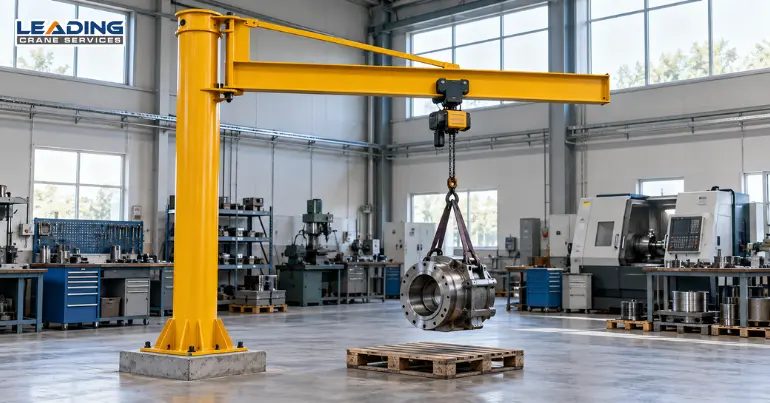
- The reach of the arm. The jib arm is engineered to adjust to varying lengths. A longer arm places the load further from the column, which changes the load the structure carries, so reach and capacity are chosen together.
- The mounting. A floor-mounted jib stands on its own column and foundation, while a wall-mounted or pillar-mounted jib fixes to a structure. The mounting has to carry both the load and the turning force.
- The hoist. The hoist does the actual lifting, so it must be rated to at least the capacity of the crane. Leading Cranes pairs the jib with a suitable hoist, such as a chain hoist for lighter duties.
Change any one of these and the safe working load changes with it. That is why capacity is decided as part of the full specification, not in isolation.
Do Not Forget the Weight of the Lifting Gear
A common mistake is to size a jib crane to the bare load and forget the equipment used to lift it. The hoist, chains, slings and any lifting beam all count against the rated capacity. Always base the rating on the heaviest load plus the gear, and choose a rating with some headroom above that. Extra margin reduces stress on the crane over its working life and keeps every lift safely inside the limit.
Working Out the Right Capacity for Your Site
You do not need to calculate the final figure yourself, but having the right information ready makes specifying the crane far quicker. Before you enquire, gather:
- The heaviest load the crane will ever lift.
- The weight of the hoist and lifting gear.
- The furthest point the load must reach from the column or wall.
- The rotation and working area you need.
- Whether the crane will be floor-mounted or wall-mounted, and the condition of that floor or structure.
With these details, Leading Cranes can recommend a capacity and configuration that suits the load, the working area and the site conditions.
Safety Comes Built In
Every jib crane from Leading Cranes is constructed in strict alignment with Australian safety standards. The rated capacity is not a target to push against but a limit to stay within. Overloading a jib crane risks the structure, the hoist and, most importantly, the people working near it. Proper specification at the start, followed by regular inspection, is what keeps the crane safe throughout its life.
A Common Problem and How to Avoid It
A frequent issue is buying a jib crane on a headline capacity figure alone, then finding it cannot lift the real load once the reach and lifting gear are taken into account. The fix is to specify capacity, reach, mounting and hoist together, based on your actual heaviest load plus the gear. Doing this once, correctly, avoids an under-rated crane that cannot do the job.
Frequently Asked Questions
Is there a fixed weight limit for a jib crane?
No. Capacity is specified for the application. A light workstation jib may be rated around 250kg, while heavier-duty jibs are configured for larger loads based on the required load, working area and site conditions.
Does the arm length affect how much it can lift?
Yes. The jib arm adjusts to varying lengths, and a longer reach changes the load the structure carries, so reach and capacity are chosen together.
Does the hoist weight count towards the capacity?
The hoist, chains, slings and any lifting beam all count against the rated capacity, so the rating should be based on the load plus the gear.
Can Leading Cranes help me choose the right capacity?
Yes. Leading Cranes helps you select a jib crane based on the required load, working area and site conditions, and pairs it with a suitable hoist.


Leave a Reply