

Gantry Crane vs Lift Assist Device: Which Suits Repetitive Lifting?
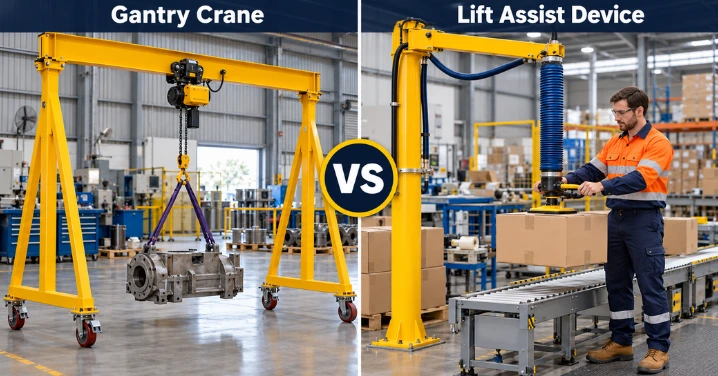
Lifting the same parts, boxes or components over and over is one of the most common causes of strain and injury in Australian workplaces. Every lift may feel manageable, but hundreds of lifts a shift add up. The right equipment can take the load off your people and speed up the work at the same time.
Two popular options are gantry cranes and lift assist devices. Both can make repetitive lifting safer, but they are designed for different jobs. This guide compares gantry crane vs lift assist device options, so you can choose the right repetitive lifting solution for your workplace.
Why Repetitive Lifting Needs the Right Equipment
Repetitive lifting is a hazardous manual task. Even moderate loads can cause musculoskeletal injuries when they are lifted frequently, from awkward positions or over long shifts. Employers have a duty under work health and safety laws to eliminate or reduce these risks, and mechanical lifting aids are one of the most effective controls.
The right equipment can also:
- Reduce fatigue and injury-related downtime
- Increase output by making each lift faster and more consistent
- Improve product handling and reduce damage
- Make jobs accessible to a wider range of workers
What Is a Gantry Crane?
A gantry crane is a crane supported by its own legs, which run on wheels or rails, or sit in a fixed position. Because it does not need to be attached to the building structure, it is ideal for workshops, outdoor yards and sites where an overhead crane is not practical.
Gantry cranes are fitted with a hoist, usually an electric chain hoist or wire rope hoist, which lifts the load vertically. They can handle anything from light loads through to many tonnes, depending on the design.
Strengths of a Gantry Crane
- Higher capacity: Handles loads well beyond what a lift assist device can handle
- Large coverage area: Spans a wide work zone or bay
- Flexible installation: No need for building columns or a runway structure
- Versatility: Handles a range of loads, from components to machinery and moulds
Limitations for Repetitive Lifting
- Hoist lifting speeds may be slower than a lift assist device for very frequent, light lifts
- The operator usually controls the lift with a pendant or remote rather than guiding the load by hand
- Positioning small parts precisely can take longer without inverter control
What Is a Lift Assist Device?
Lift assist devices are designed to make lifting light to medium loads feel almost weightless. The operator guides the load by hand, while the device takes the weight. They are often used where the same task is repeated many times a shift.
Common types of lift assist devices include:
- Vacuum tube lifters, which use suction to grip and lift boxes, sacks, panels and sheets
- Pneumatic or electric balancers, which balance the weight of a load or tool so it can be moved easily
- Manipulator arms, which grip, lift and rotate parts with a rigid arm for precise positioning
- Intelligent assist devices, which use sensors and motors to respond to the operator’s hand movements
Lift assist devices are usually mounted on a jib crane, workstation crane, light crane system or gantry, which provides the reach and coverage.
Strengths of a Lift Assist Device
Fast, natural movement: Ideal for high-frequency lifting
Precise placement: The operator guides the load directly
Excellent ergonomics: Reduces bending, twisting and reaching
Specialised grippers: Vacuum pads, clamps and custom tooling can be matched to the product
Limitations of Lift Assist Devices
- Generally designed for lighter loads than cranes
- Usually need to be tailored to a specific product or task
- Often rely on a supporting crane structure for coverage
Gantry Crane vs Lift Assist Device at a Glance
| Factor | Gantry crane | Lift assist device |
| Typical loads | Light to very heavy | Light to medium |
| Lifting frequency | Low to moderate, or high with the right hoist and controls | High, repetitive lifting |
| Speed per lift | Moderate | Fast |
| Control | Pendant or remote, hoist does the lifting | Hand-guided, near-weightless movement |
| Precision | Good, better with inverter drives | Excellent for placing and rotating parts |
| Coverage | Large work areas and bays | A workstation or defined area, depending on the supporting structure |
| Installation | Freestanding, no building support needed | Mounted on a jib, workstation crane, light crane or gantry |
| Best for | Heavy or varied loads across a large area | Repetitive handling of similar items at a workstation |
Which Is Right for Repetitive Lifting?
When comparing a gantry crane vs lift assist device for repetitive lifting, start with the load, the number of lifts and the area you need to cover.
Choose a Gantry Crane if:
- Your loads are heavy or vary in size and weight
- You need to cover a large work area or move loads between bays
- Lifts are frequent but not extremely high volume
- You need a freestanding structure because the building cannot support a crane
A gantry crane for repetitive lifting works best when it is paired with the right hoist. An electric chain hoist with inverter control, for example, gives smoother starts and stops and more precise positioning for frequent lifts. Read our guide to electric chain hoists vs wire rope hoists for help choosing.
Choose a Lift Assist Device if:
- Workers lift the same or similar items many times a shift
- Loads are light to medium, such as boxes, sacks, panels or components
- Speed and precise, hand-guided placement are important
- The task is fixed at a workstation, packing line or machine
Consider Combining Both
In many workplaces, the best solution is a combination. A gantry, jib or workstation crane provides the structure and coverage, while a lift assist device or ergonomic hoist handles the repetitive lifting. This gives you the reach of a crane with the speed and ergonomics of a hand-guided lift.
Questions to Ask Before You Choose
- What is the heaviest load, including grippers and below-the-hook equipment?
- How many lifts are made per hour or per shift?
- How far and how high does each load need to move?
- Does the load need to be rotated, tilted or placed precisely?
- Is the task fixed at one workstation or spread across a larger area?
- Can the building support a crane, or is a freestanding structure needed?
Answering these questions helps narrow down the right option in any industrial lifting equipment comparison. For more on capacity, see Understanding Crane Load Capacity: How Much Can a Crane Lift?
Maintenance and Safety
Whichever equipment you choose, it must be installed, inspected and maintained correctly. Gantry cranes and hoists need regular inspections and servicing in line with Australian Standards and the manufacturer’s instructions, and lift assist devices also need routine checks of hoses, seals, grippers and controls. Operators should be trained on safe use and know the rated capacity of every component.
Repetitive Lifting Solutions From Leading Cranes
Leading Cranes designs, supplies, installs and maintains gantry, jib, workstation, light crane and freestanding crane systems, along with electric chain hoists and wire rope hoists with options such as inverter drives for smoother, more precise control. We can assess your lifting tasks, recommend the right structure and hoist for repetitive work and provide installation, inspections and ongoing maintenance.
Call 1300 225 323 or request a free quote to find the right repetitive lifting solution for your workplace.
Frequently Asked Questions
Is a gantry crane or lift assist device better for repetitive lifting?
For frequent lifting of light to medium items at a workstation, a lift assist device is usually faster and more ergonomic. For heavier or varied loads across a larger area, a gantry crane is usually the better choice.
Can a lift assist device be mounted on a gantry crane?
Yes. Lift assist devices are often mounted on gantry, jib, workstation or light crane systems, which provide the reach and coverage.
What loads can lift assist devices handle?
Most lift assist devices are designed for light to medium loads. Check the rated capacity of the device and its supporting structure for your application.
Do lifting aids help meet manual handling obligations?
Mechanical lifting aids are a recognised way to reduce risks from hazardous manual tasks, including repetitive lifting. Employers should also assess the task, train workers and maintain equipment.
How do I choose the right repetitive lifting solution?
Look at load weight, lifting frequency, movement, precision and the work area. A lifting specialist can assess your task and recommend the right equipment.
Leave a Reply