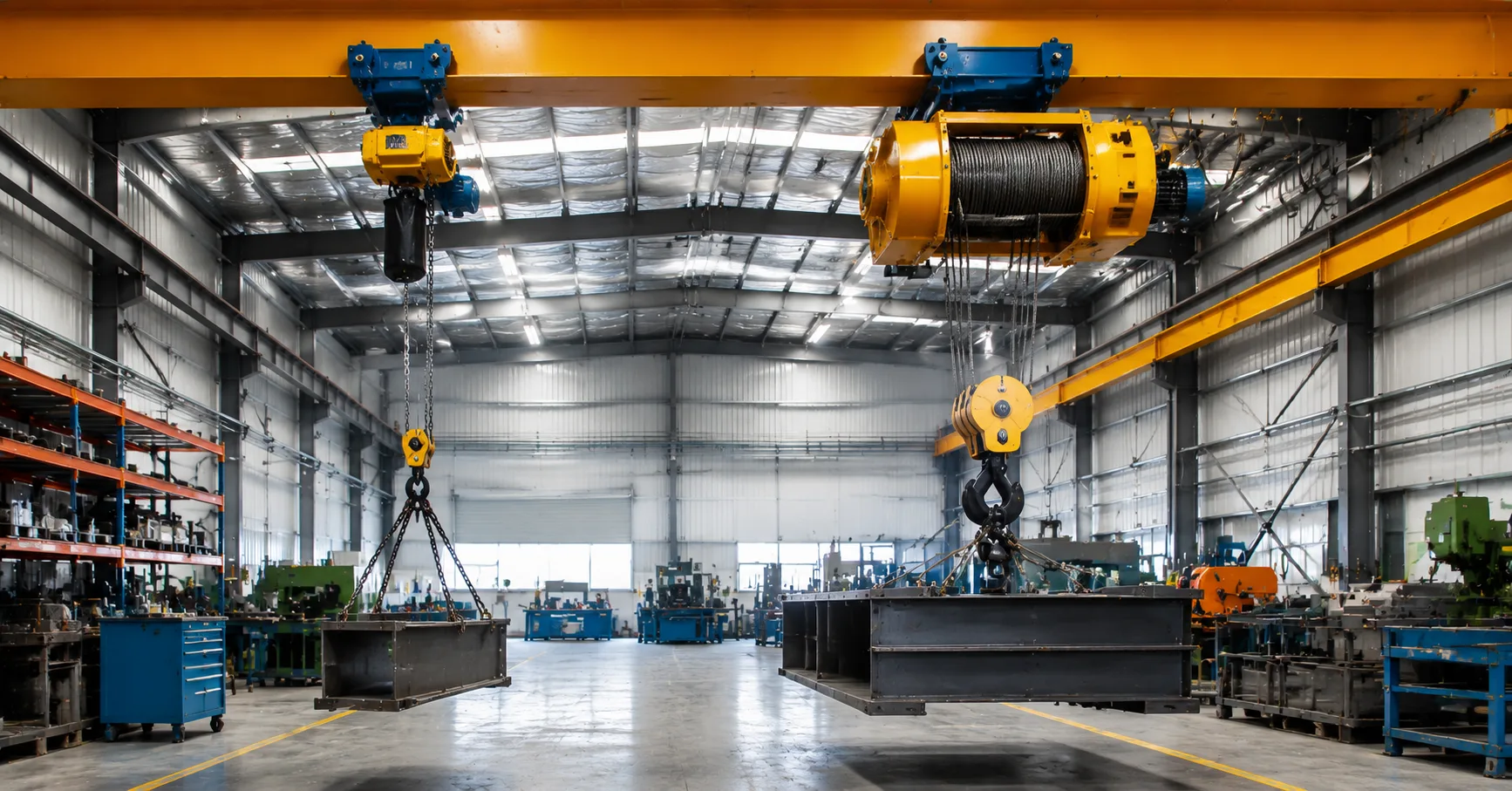
A hoist is the part of a crane that does the lifting, and the two main types are chain hoists and wire rope hoists. Choosing between them is mostly a question of how much you need to lift and how the hoist will be used. Pick a chain hoist for a duty that suits a wire rope hoist, or the reverse, and you end up with equipment that is either overworked or oversized. This guide explains the differences so the choice is clear.
Chain Hoists
A chain hoist lifts the load on a chain. It is the common choice for light-duty to medium-duty work and for lower lift heights. Leading Cranes supplies chain hoists with capacities from 50kg to 6.3 tonnes, from brands including STAHL, Verlinde, Hitachi, KITO PWB, GIS and SWF.
Options available on chain hoists include:
• Explosion-proof hoists for Zone 1, 21 and 22 areas.
• Short headroom trolleys.
• Dual chain hoists.
• Big bag hoists, designed for lifting bags and bulky loads.
• Inverter-driven hoists and drives.
• Hook or eye mounting, and custom builds.
Wire Rope Hoists
A wire rope hoist lifts the load on a steel wire rope wound onto a drum. It handles higher capacities and greater lift heights, and suits heavy-duty and high-cycle work. Leading Cranes supplies wire rope hoists with capacities from 500kg to 60 tonnes, from brands including STAHL, Verlinde, GH, SWF and ABUS.
Options available on wire rope hoists include:
• Explosion-proof hoists for Zone 1, 21 and 22 areas.
• Short headroom trolleys.
• Dual hoisting and twin drive.
• Inverter-driven hoists and drives.
• Underslung, torsion mount or top mount.
• Secondary hoisting brake, and molten metal or high-risk load cranes.
The Key Differences
• Capacity. Chain hoists run from 50kg to 6.3 tonnes. Wire rope hoists run from 500kg to 60 tonnes, so heavy lifting points to wire rope.
• Duty and use. Chain hoists suit lighter and lower-cycle work. Wire rope hoists suit heavier, higher-cycle and greater lift-height work.
• High-risk loads. For molten metal and other high-risk loads, wire rope hoists can be configured with secondary braking and specialist options.
• Shared options. Both types are available explosion-proof for Zone 1, 21 and 22, with short headroom trolleys, inverter drives and custom builds.
How to Choose
Start with the heaviest load and the lift height. If both are modest and the work is light to medium duty, a chain hoist is usually the right fit. If the load is heavy, the lift is high, or the duty cycle is demanding, a wire rope hoist is the better match. Then layer on the site conditions, because every site has varying environmental and production requirements, and every hoist installation needs a customised plan with attention to selecting the perfect hoist for the application. Explosion proof areas, high-risk loads and tight headroom all shape the final specification.
Where Their Capacities Overlap
The two ranges cross between 500kg and 6.3 tonnes, where either a chain hoist or a wire rope hoist could do the job. In that overlap, the deciding factors are the lift height and the duty cycle. For frequent lifting, greater lift heights or demanding cycles, a wire rope hoist tends to be the more durable choice, even inside the range a chain hoist could technically handle. For occasional, lower lifts, a chain hoist keeps the setup simpler. This is where advice on the specific application pays off.
Keeping Either Hoist Reliable
Both hoist types last longer and stay safe with routine servicing, and both draw on the same repair support. Wire rope and bottom block repairs renew frayed wires and hooks so the load is lifted safely, while spare parts for the majority of hoist models are held in stock to keep downtime short. Choosing the correct hoist for the duty is the first step, and maintaining it properly is what keeps it working.
Frequently Asked Questions
What is the capacity range of each hoist type?
Chain hoists are supplied from 50kg to 6.3 tonnes. Wire rope hoists are supplied from 500kg to 60 tonnes.
Which hoist is better for heavy lifting?
A wire rope hoist, because it covers the higher capacity range up to 60 tonnes and suits heavy-duty, high-cycle work.
Are explosion proof hoists available in both types?
Yes. Both chain hoists and wire rope hoists are available explosion proof for Zone 1, 21 and 22 classified areas.
Can I get a custom hoist for my site?
Yes. Both types can be built to suit specific site conditions, load types and operational requirements, with a customised plan for the application.
Which brands do you supply?
Chain hoist brands include STAHL, Verlinde, Hitachi, KITO PWB, GIS and SWF. Wire rope hoist brands include STAHL, Verlinde, GH, SWF and ABUS.


Leave a Reply